Stuck at the muscle-up? The transition is the problem
Months of pulling and still no muscle-up? The transition is a skill, not a strength gap. The progression ladder that fixes it, step by step.
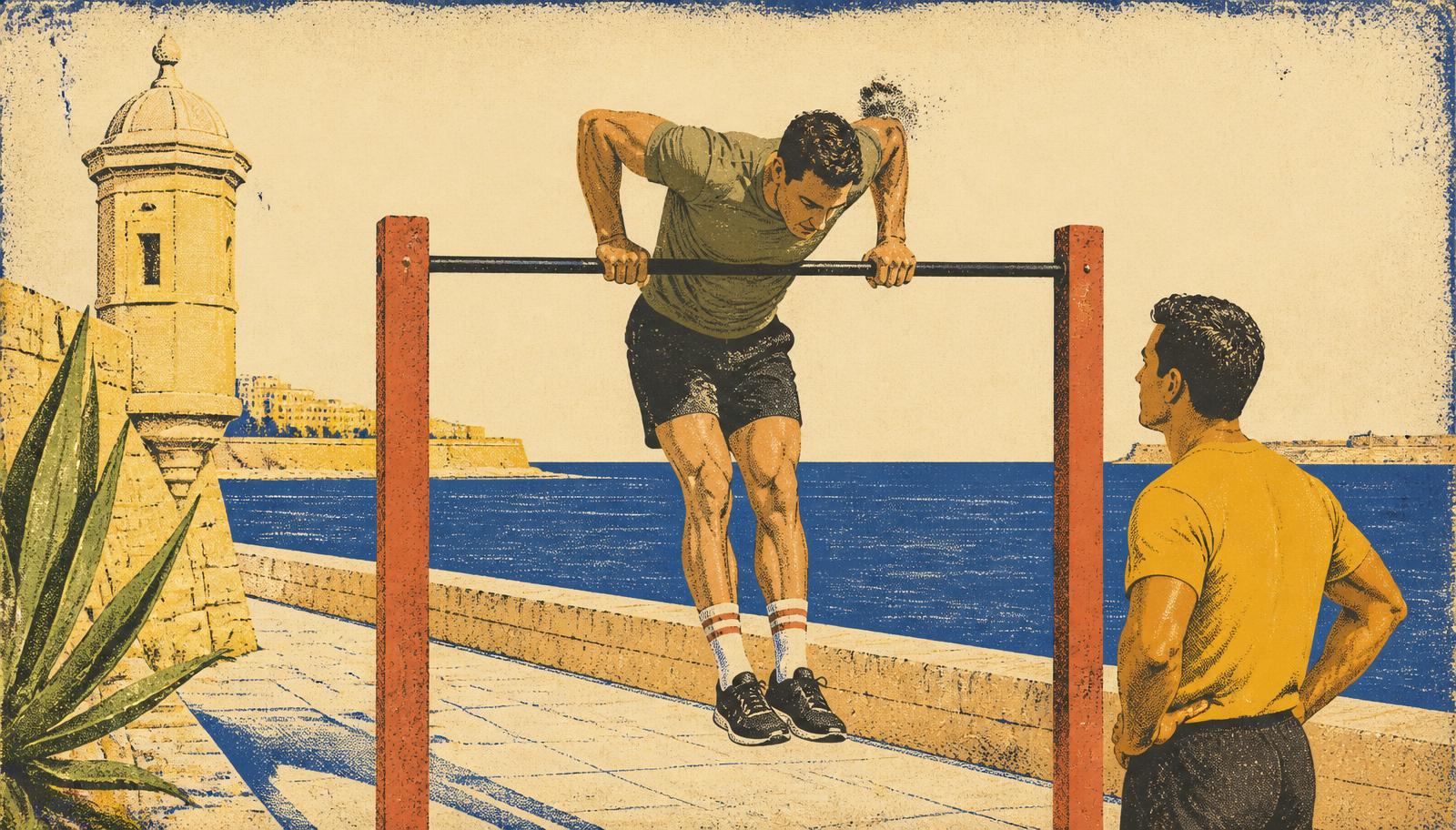
You can do ten pull-ups. Your dips are solid. You've watched every muscle-up tutorial the algorithm owns, and you've been throwing yourself at the bar for months — and you're still stuck at exactly the same place: chest-height, chin over the bar, and then that moment where you're supposed to be above the bar and instead you're just… hanging there, again.
Here's the diagnosis, and it's probably not the one you want: you don't have a strength problem. You have a ladder problem.
Why you're stuck
The muscle-up transition — that instant where a pull becomes a dip — isn't a harder version of pulling. It's a different skill: a rapid shift of the shoulders from below the bar to above it, driven by bar path, wrist position and timing far more than by raw force. This is why guys who can do fifteen pull-ups stall at the transition while lighter, "weaker" athletes float over: the strong guy is trying to pull through a moment that has to be steered through.
And it's why your current approach isn't working. Random hard workouts — max pull-ups Monday, kipping attempts Wednesday, more attempts Friday — build fatigue and groove the exact failure you're practising. Skills don't respond to effort dumped on them in a pile. They respond to ladders: ordered progressions where each rung has a quality gate, and the next rung only opens when this one is genuinely owned.
The ladder
The transition breaks down into rungs. Roughly, from the bottom:
- High pull-ups with intent — chest to bar, elbows driving back, and crucially a slight false grip or wrist-over preparation at the top. Gate: 5 clean reps touching lower-chest height, no kip degradation.
- Bar-path pulls — pulling not straight up but in a slight C towards and around the bar. This is the single most under-trained piece. Gate: video shows the bar finishing at your sternum with elbows behind you, not flaring sideways.
- Transition negatives — start on top, lower through the transition as slowly as you can. This is where the movement is actually learned. Gate: 3 controlled 5-second negatives without dropping through the sticking point.
- Band or feet-assisted transitions — the full movement with just enough help to keep the path honest. Gate: assistance measurably shrinking week to week, path unchanged.
- The first strict rep — which, done via this ladder, tends to arrive quietly on an ordinary Tuesday rather than as a max-effort miracle.
Each rung has a purpose, each has a gate, and skipping rungs is precisely the stall you've been living in. Months of attempts at rung 5 without owning rung 3 is not persistence — it's rehearsal of failure. If you would rather not gate your own rungs, that is what calisthenics coaching in Malta is for.
Where the app comes in
This ladder — and the same structure for the first pull-up, the handstand, the front lever and the rest — lives in the LivingFit app, with video demos for every rung filmed on the same Maltese park bars you train on. The tier system is the point: perform a rung at target quality and the next one unlocks automatically; fall off the standard and it steps you back without drama. It's the structure piece you've been missing, and it's free — actually free, forever, no card, no trial countdown. It's built for exactly the person who would never pay for a personal trainer, and that's fine. The one thing that reliably breaks a ladder is missing weeks of it, and that is usually travel; here is how to keep a progression running on the road.
If you want eyes on it
Some transitions have one stubborn, personal glitch a video demo can't see. For that there's a different offer: not "train with me", but a single session or a short block with one named outcome — get your muscle-up. We film, find your specific leak, fix the rung it lives on. When it's done, it's done.
But start with the ladder. You're one honest progression away, and you've already done the hard part — you just did it in the wrong order.
Written by Sean Dunbar Smyth.