How to get your first pull-up
Most people chasing a first pull-up are training the wrong thing: repeated failed attempts. Here is the progression ladder that works, step by step.
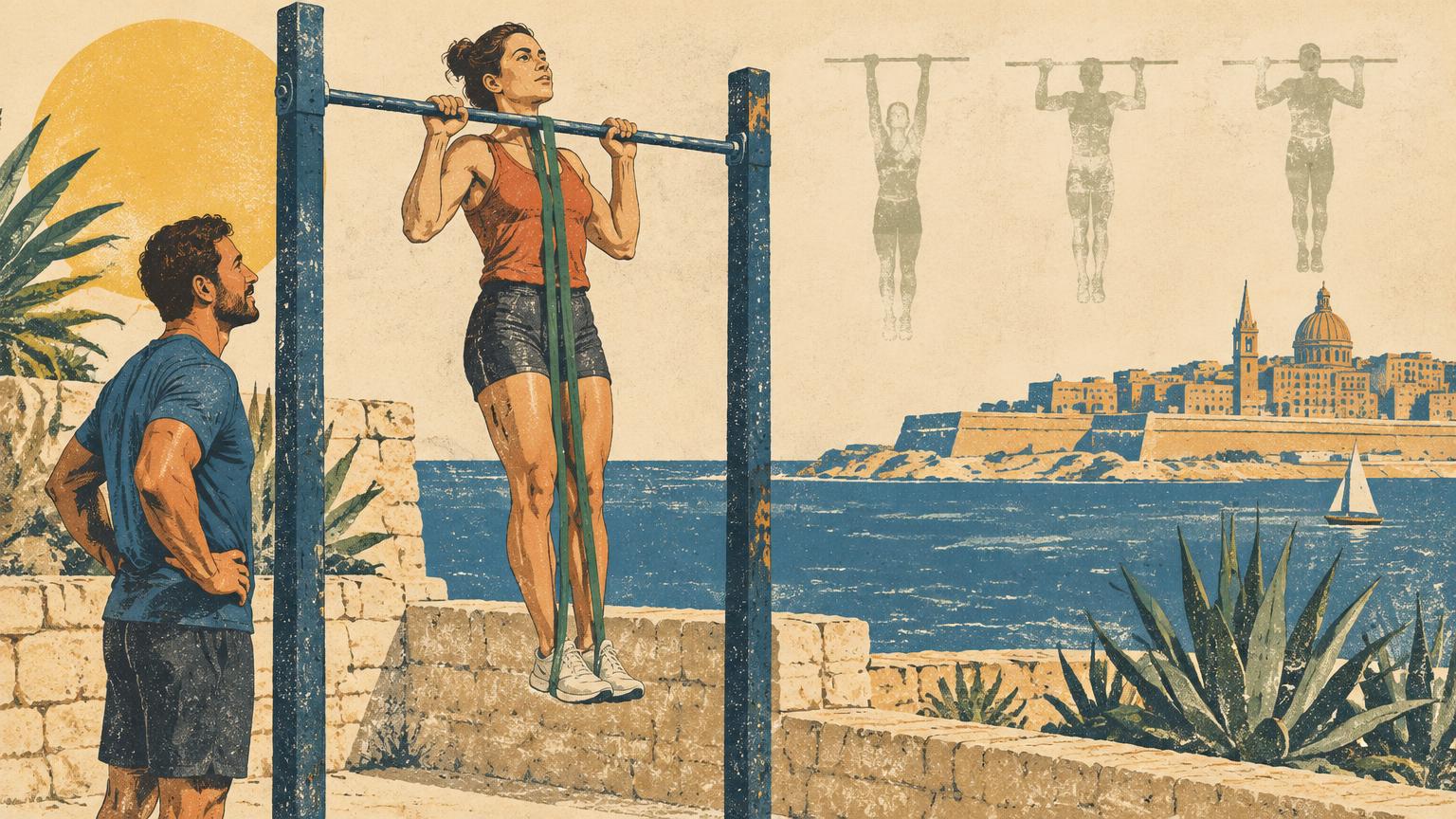
Most people trying to get a pull-up are training the wrong thing. They hang, they strain, they drop, and they repeat that three times a week for months. The gap never closes, because a failed attempt is a test, not a session.
A pull-up is a skill with a ladder under it. You climb the ladder, and the pull-up arrives.
Why repeated attempts stall.
An attempt you cannot complete teaches your body very little. You get a few seconds of maximal effort, then failure, then a long rest. Your total volume stays near zero, and volume is what builds the pattern.
The fix is to train positions you can hold and movements you can complete, for enough repetitions to matter.
The ladder.
1. Dead hang. Hang from the bar with your shoulders active rather than slumped into the joint. Work towards 30 seconds. This builds grip and teaches your shoulders to accept load overhead.
2. Scapular pulls. From the hang, pull your shoulder blades down and back without bending your elbows. Small range, and the step almost everyone skips. 3 sets of 8.
3. Ring rows. Feet on the floor, body at an angle, chest to the rings. Lower the angle as you get stronger. This is where most of your early pulling volume should live. 3 sets of 8 to 12.
4. Negatives. Jump or step to the top, chin over the bar, then lower yourself as slowly as you can. Aim for 5 seconds down. 4 or 5 single reps, while you are fresh, not tacked onto the end of a session.
5. Band-assisted pull-ups. A band under the knee or foot takes some of your bodyweight at the hardest point. Move to a thinner band over time rather than adding reps forever.
6. The pull-up. One clean rep from a dead hang, chin over the bar, no kick.
How often, and how much.
Two or three pulling sessions a week, with at least a day between them. Stop each set two reps short of failure. You are building a pattern, not proving anything.
Change one variable at a time: hold a little longer, lower a little slower, or drop to a thinner band. Changing everything at once tells you nothing about what worked.
Where the app comes in.
The free Living Fit app puts this ladder in order and moves you up it on evidence. Clear a tier at target quality and the next one appears. Struggle with it, and the app steps you back rather than leaving you stuck on something you are not ready for.
It also reads your readiness first, from three quick questions or a synced wearable, and sizes the session to the day. Sleep badly and the volume shortens. That matters on a skill like this, where the quality of each rep is the whole point.
No card, no trial clock. It is free, and it stays free.
Training outdoors.
Malta's public park bars are a good place to do this work, and they cost nothing. A set of rings and one band in a rucksack covers most of the ladder.
If you would rather have someone watching your technique, that is what calisthenics coaching in Malta is for. Sean is an Advanced Level 3 coach, and the first session is free.
One caution.
If you have a shoulder, elbow or wrist problem, get it looked at by a doctor or physiotherapist before you start loading it overhead. Training around a painful joint is how small problems become long ones.
After the pull-up.
Once you have a clean rep, the next question is usually the muscle-up, and the transition is where nearly everyone gets stuck. That is a separate skill with its own ladder.
Pulling has a partner, too. Most programmes pair pull-ups with dips, and the dip has a ladder of its own.
Two ways to start: book a free first session, or start free in the app.
Written by Sean Dunbar Smyth.