Is it safe to lift weights at 60? An honest answer
The honest answer to whether lifting weights is safe at 60: what changes with age, what supervision adds, and when to talk to your GP first.
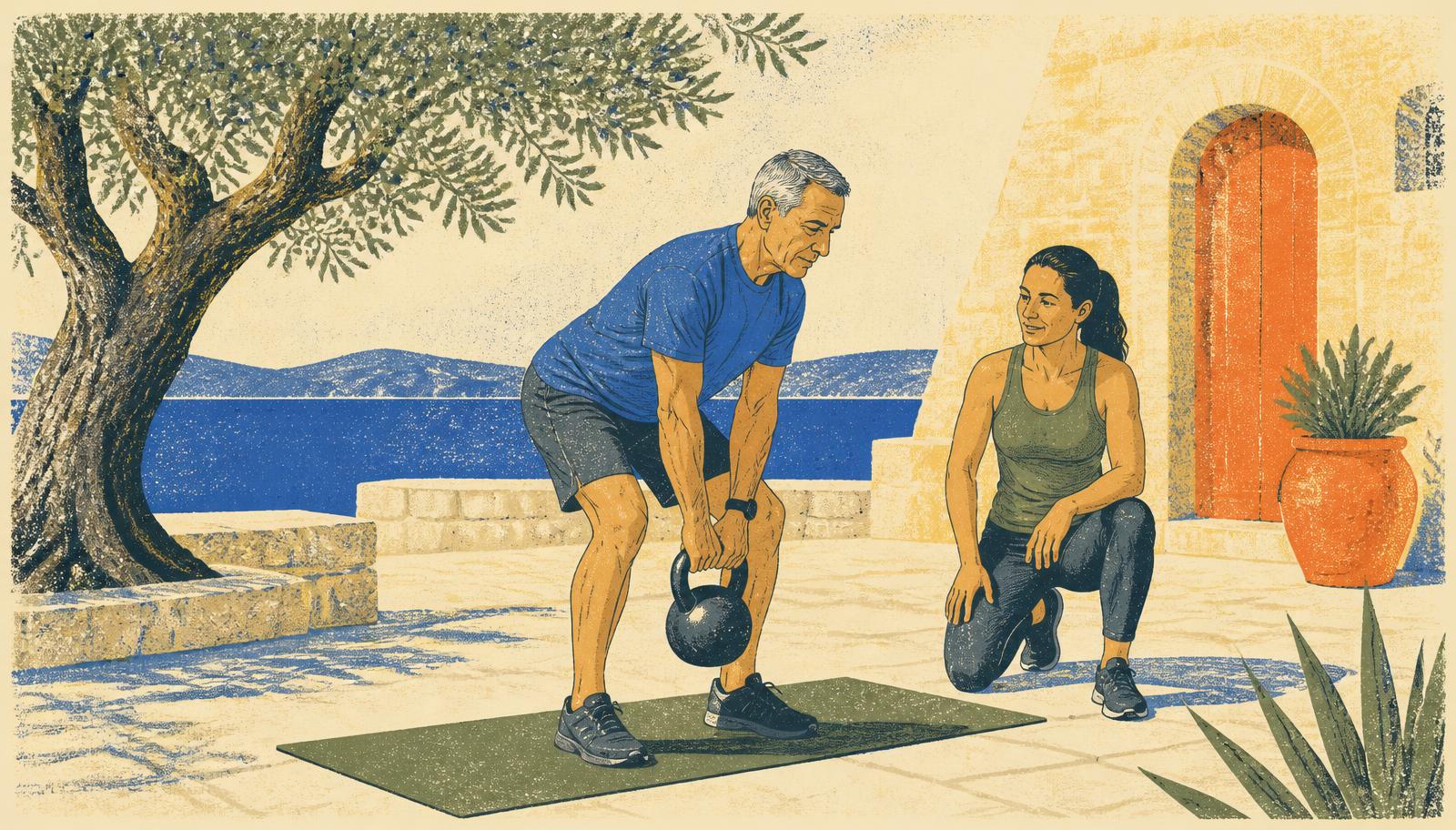
The question usually arrives apologetically, as if it were somehow silly: "Isn't lifting weights a bit dangerous at my age?"
It isn't silly. It's the single most sensible question you could ask, and it deserves a straight answer rather than a slogan. So here is the straight answer, with the caveats left in.
The short version
For most people in their sixties, supervised strength training — started gently, progressed gradually, with proper screening beforehand — is not only reasonably safe but one of the most worthwhile things you can do for your day-to-day capability: your steadiness, your ability to carry things, to rise from a chair or the floor easily, to trust your own body on an uneven pavement.
Notice the qualifiers, because they're doing real work in that sentence: supervised, started gently, progressed gradually, with proper screening. Unsupervised enthusiasm is where the trouble lives — at 60 exactly as at 25, just with less margin.
What actually changes with age
Three things, honestly stated:
- Recovery slows. The work still works — muscles respond to training at every age — but the time your body needs between sessions grows. A programme for a 60-year-old that ignores this is just a young person's programme with the dates changed, and it will grind you down rather than build you up.
- Tissues adapt more slowly than strength does. You can get stronger faster than your tendons and joints get more robust. This is why progression must be patient and earned, never rushed to chase a number.
- The starting point varies enormously. At 60, two people can be decades apart in practical terms. This is why screening matters and why generic plans serve older adults so badly.
None of these is a reason not to train. Each is a reason not to train carelessly.
What supervision changes
With older clients I am, frankly, more patient than with anyone else I coach: more time on each movement, closer attention to form, smaller jumps between levels. Nothing gets loaded until the unloaded movement is comfortable. Anything you flag as a past problem stays out of the programme until the work around it has earned it back — and "we just don't do that one" is always an acceptable permanent answer.
My clients range from 16 to 75. The 75-year-olds are not doing diluted versions of the 25-year-olds' sessions; they are doing their own sessions, built for their own bodies, progressed at their own speed. That's the entire point of coaching. There's a fuller picture of what strength training over 50 in Malta actually involves, including the practical details a family member usually wants to check.
When to talk to your GP first
This is a real checklist, not legal decoration. Speak to your GP before starting if any of these apply:
- A heart condition, or chest pain during activity
- Uncontrolled blood pressure
- Recent surgery, a recent fall, or an injury that hasn't been assessed
- Bone density concerns you've been advised about
- Dizziness or balance episodes
- Any condition you're under active treatment for, where exercise hasn't been discussed
None of these necessarily rules training out — in many cases a GP will be actively pleased you asked. But the conversation comes first, and if you'd like, I'm happy for your GP or physiotherapist to know exactly what a programme with me would involve.
What a first session at 60 looks like
A conversation, first — history, concerns, what you want day-to-day life to feel like. Then gentle moving warm-up, a handful of fundamental movements learned unloaded or lightly loaded, and practising getting down to the floor and confidently back up. You will not be tested, rushed, or made to prove anything. You'll leave knowing your starting point.
The first session is free, there are no contracts, and sessions can run at your home if travelling to a studio is the obstacle. Booking is by phone — you'll speak to me directly.
Please note: this article is general information, not medical advice. If you have a medical condition or have been advised to limit activity, talk to your GP or physiotherapist before beginning any exercise programme.
Written by Sean Dunbar Smyth.